Oviedo Declaration
Ten proposals for incorporating Prevention in drug policies
Drug use continues to pose evident challenges to populations worldwide. In just one
decade, drug use has grown by 23%. At the same time, science proved that a
significant portion of drug-use related problems is preventable. The 2023 World
Drug Report of the United Nations Office on Drugs and Crime (UNODC) identified
the need to provide and implement international large-scale drug-use prevention
initiatives.
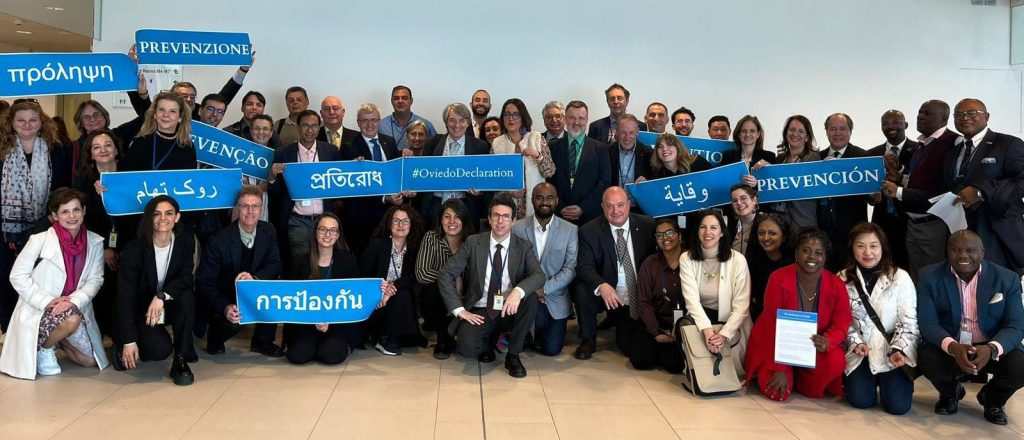
On June 9th, 2023, national and international experts met in Oviedo, Spain, in a
consultation organized by Proyecto Hombre, to explore effective strategies for
preventing drug use aligned with international scientific standards. Such strategies
address vulnerabilities linked to negative social and health consequences as well
as addictive behaviors. Stemming from the consultation, the following declaration
has been adopted to scale up prevention at the forefront of drug policy.
In accordance with the existing global declarations and political commitments that
function as road maps for countries, namely the 2016 UNGASS Outcome Document
and the 2019 Ministerial Declaration that highlight the value of evidence-based
prevention and especially mentioning the UNODC/WHO International Standards on
Drug Use Prevention.
Further encouraged by the recent resolution of the United Nations Commission on
Narcotic Drugs: 65/4 “Promoting Comprehensive and Scientific Evidence-based
Early Prevention”, the supporting organizations of the Declaration of Oviedo aim at
reinforcing and fully engaging with the objectives of these political declarations and
commitments while re-accelerating progress towards the Sustainable Development
Goals through the following ten proposals.
1. https://www.unodc.org/res/WDR-2023/WDR23_Exsum_fin_SP.pdf
2. https://www.unodc.org/res/WDR-2023/Special_Points_WDR2023_web_DP.pdf
3. https://proyectohombre.es/
https://www.proyectohombreastur.org/
4. https://www.unodc.org/documents/postungass2016/outcome/V1603301-E.pdf
5. https://www.unodc.org/documents/hlr/19-06699_E_ebook.pdf
6. https://www.unodc.org/documents/prevention/UNODC-WHO_2018_prevention_standards_E.pdf
7. https://www.unodc.org/documents/commissions/CND/CND_Sessions/CND_66/ECN72023_CRP8_2303657E.pdf
Proposals
1. Call for countries to dedicate at least 25% of their drug demand reduction strategy and policy budget on prevention by 2030
Considering existing evidence on effective and cost-effective prevention, we urge countries to
achieve a national consensus by 2030, committing to allocate and sustain at least a quarter of the total drug-demand policy budget to drug prevention. Furthermore, we reiterate that policies should be proportionately balanced between drug demand and drug supply reduction measures, whilst ensuring public health and safety for all individuals and guaranteeing their human rights.
2. Promote an approach to prevention targeting all ages of development and favoring earlier prevention
Prevention should start as early as possible and consider the periods starting from pregnancy, neonatal, childhood and adolescence, by identifying priority family, school, and community intervention areas, and continuing in adulthood. Effective prevention focuses on strengthening protective factors and empowering individuals throughout their lives on personal, emotional, and social levels.
3. Foster research and evaluation to avoid ineffective or counterproductive prevention strategies
Prevention is a science. As such, formulating and implementing prevention policies should
incorporate evidence-based, data-driven interventions and systematic assessment mechanisms guided by international standards in strong collaboration with academia and civil society organizations. This approach is essential to refrain from drug policies based on misperceptions and misbeliefs. Furthermore, investing in research transferability is of high importance to ensure the implementation of effective prevention in different social, economic, political, and cultural contexts.
4. Broaden the vision of prevention responses to shift the focus from drugs to the individual and the community
By focusing on the person rather than the drugs, preventive interventions take into consideration vulnerabilities at the individual level and the potential protective effect of the social structures and the legislative framework surrounding the person. This approach prevents not only the use of illicit drugs but all drugs in general, including tobacco, alcohol, cannabis, prescription drugs, or new synthetic substances that are highly prevalent. This would also encompass prevention of non substance addictions such as gambling and digital gaming disorders.
5. Mainstream intersectional approaches in prevention for all populations at risk
The impact of drug use is inequitable and highly dependent on social determinants of health that are influenced by several factors, including identities relating to gender, ethnicity, age, sexual orientation, and location of residence, among others. Therefore, prevention strategies must incorporate a holistic, intersectional approach addressing different vulnerabilities to allow for the establishment of more equitable and fair policies. Prevention services should make all efforts to cover and prioritize the most excluded and stigmatized groups, such as unaccompanied minors, houseless people, people with mental health disorders, migrant and displaced populations, Indigenous Peoples and others. This would require prevention responses tailored to the specific
needs of each individual in each context.
6. Boost multi-stakeholder prevention systems and documenting effectiveness and cost-effectiveness when implemented globally
Systems of prevention should bring together diverse measures and coordinated efforts from multiple governmental, non-governmental, and community-based sectors to provide services, at scale, for children, youth, and at different ages of development. Countries should benefit from available prevention services at national and local levels when aligning them to international scientific standards. Therefore, more should be invested to replicate prevention models that have proven their effectiveness and cost-effectiveness at the international level.
7. Provide universal coverage in a continuum of care
In line with a public health approach, countries should provide drug prevention that is accessible and affordable for all individuals everywhere, globally and locally, and intertwined with the provision of health promotion, early detection and intervention, harm reduction, addiction treatment, recovery and social integration, in a logic of continuum of care.
8. Prioritize action in low- and middle-income countries
In low- and middle-income countries, and regions experiencing humanitarian crisis, basic social and health care infrastructure may be lacking. In these contexts, investing in prevention should be a key priority. We encourage building strong partnerships between governments, international organizations, civil society, and the private sector, as well as prevention experience exchanges and contextualizing and localizing prevention strategies based on a do-no-harm approach. We also encourage implementing initiatives to empower families, other caregivers, youth-based, and community-based leaders.
9. Empower current and future generations of prevention professionals
Recognizing the key role of professionals in implementing effective prevention, we urge the
educational community to incorporate the science of prevention of risk behaviors in core and compulsory curricula of health, education, and social science teaching. We also stress the need to provide certification processes and continuous training for prevention practitioners throughout their working careers and ensuring supportive conditions to avoid burnout.
10. Monitor the status of prevention policies through accountable surveillance
We invite countries, the Commission on Narcotic Drugs, the United Nations Office on Drugs and Crime, the World Health Organization, and related organizations to adequately assess the coverage, relevance, implementation, investment, and effectiveness of drug prevention policies in their jurisdictions through ongoing surveillance and data-reporting systems of international, regional, national, and local monitoring drug reports or by establishing ad hoc monitoring, in solid collaboration with civil society.
Supporting organizations:
The period of adhesions will start on the 1st of January 2024. The Declaration will be launched at the 67th Session of the UN Commission on Narcotic Drugs in 18th-22nd of March 2024. To sign and view the list of supporting organizations:
www.oviedodeclaration.org
With the collaboration of:
Susana Al-Halabí, Eulalia Alemany, Alfonso Arana, Andrea Ascari, Graciela Barreto, Karen
Biggs, José María Blanco, Jessica Bolaños, Doug Bond, Luís Bononato, Nicolas Bourguignon,
Ilko Boyadzhiev, Michal Budniakiewicz, Pedro Caceda, Selva Careaga, Fabián Chiosso, Ibe
Christogonus, Ashley Colon, Nicolás Conde, Joe Coyte, Calixta De Balmaceda, Mari Paz De La
Puente, Marta Del Arco, Cristina Delgado, Natacha Delmotte, Paulo Azevedo Dias, Covadonga
Díaz, Markéta Dolejsi, Alasana Drammeh, Cristian Duarte, Maria Àngels Duch, Oriol Esculies*,
Gonzalo Esquivel, Aránzazu Fernández*, José Ramon Fernández-Hermida, Souraya Fremm,
Orsolya Gancsos, Lucía Goberna*, Alba González, Eliseo González, Marta González, Yoana
Granero, Sharif Hamid, Patrick Harvey, Amir Hasanović, Eider Hormaetxea, Jhonny Huanto,
Martin Infante, Ruslan Isaev, Julio César Jonte, Phaedon Kaloterakis*, Habib Taigore Kamara,
Rogers Kasirye*, Raffi Kaypekian, Kyoko Kondo, James Koryor, Matej Košir, Pablo Kurlander,
Alex Lee, Domingo Legua, Paola Lami, Faisal Latif, Thomas Legl, Manuel Enrique López,
Marianella Lorenzo, Wadih Maalouf, Quetzalli Manzano, Regina Mattsson*, Gabriel Mejía,
Orlando Menéndez, Guilherme de Sousa Meneses, Manuel Mingorance, Peter Moilanen, Jesús
Morán, Gladness Hemedi Munuo, Sonja Phutachad Neef*, Danil Nikitin, Augusto Nogueira*,
Irene Núñez, George Ochieng Odalo, Jorge Olivares*, Carmen Orte, Nuria Parada, Belén Pardo,
Virginia Pérez, Elena Presencio, Lidia Clara Rodríguez, Lucas Roncati, Patricia Ros, Miguel
Rubio, Margarita María Sánchez, Adriano Schuster, Luis Sdoia, Roberto Secades, Rosario
Sendino, Dharav Shah, Elias Siboniyo, Ondřej Sklenář, Stig Erik Sørheim, Eva Tenorio, Fabián
Tonda, Lohanis Ureña, Shane Varcoe, Eloísa Velarde, Olga Vicente, Cristina Von Sperling,
Diana Vincent, Ina Vutkariov, Dandy Yela, Natalia Zachartzi*, Mikhail Zharkov.
*Task Force. Contact:
Observers*:
contact@oviedodeclaration.org
Spain (Government Delegation for the National Plan on Drugs, Ministry of Health)
United Nations Office on Drugs and Crime (Prevention, Treatment and Rehabilitation Section)
Council of Europe (Pompidou Group)
University of the Balearic Islands (Social and Educational Training and Research Group)
University of Oviedo (Addictive Behavior Research Unit)
Vienna NGO Committee on Drugs
*Observers do not necessarily agree with the content of the declaration